Tuesday, June 27, 2023

This Blog Is Moving after 14 Years!


I started writing this blog in October of 2009, after the publication of my first book, Ruth by Lake and Prairie. Ruth's story tells about the 1831 journey to what would one day become Naperville, Illinois. This Kate's Brief History blog let me share tidbits of history about Naperville, DuPage County, and Illinois. All the bits that I loved researching, but which didn't get into the book. 

Later local history also showed up in these posts because I was offering a monthly history lesson to fellow business folk at the Naperville Chamber of Commerce. It only made sense to know more about the city in which we were doing business!

As I progressed with my Agatha Christie research, I started writing more about England in the early 1900s. I am thrilled to report that the glossary, Agatha Christie Annotated: Investigating the Books of the 1920s has now been published and with it, a brand new website at AgathaAnnotated.com.

I have also been blogging at my author website, KateGingold.com, for many years, but I decided that it's time to bring the blogs together. From now on, both blogs can be found at AgathaAnnotated.com/Blog

Thank you so much for following me here at Kate's Brief History and I do hope you will follow me over to AgathaAnnotated as we start something new!

Friday, June 9, 2023

June Is a Lovely Month in England to Look at Gardens - and History

Agatha Christie's brother, Monty
agathachristie.fandom.com/wiki/Monty_Miller
While thinking about a topic for this month’s post, I wondered if there was an Agatha Christie-related or 1920s event that happened in June to write about. I did a little online research – and then created my own event!

If you’re into gardens, you can find videos online of gorgeous English gardens and learn what’s blooming in June. And speaking of blooms, search results bring up the famous poem “O my Luve is like a red, red rose/That’s newly sprung in June,” although Robert Burns is actually the national poet of Scotland, not England. Looking a bit further, I read that Burns also wrote the words to “Auld Lang Syne,” which I already knew, and that he died at the age of thirty-seven, which I did not know.

June seems to be a good month for crowning English monarchs. The coronations of Henry VIII and his first wife, Catherine of Aragon were held in June of 1509. Henry’s second wife, Anne Boleyn, was crowned in June of 1533. Anne’s reign only lasted until 1536, but 420 years later, England celebrated the coronation of Elizabeth II, and she is considered the second-longest-reigning monarch of all time. Louis XIV beat her record, having ascended the throne at the age of four.

Since Agatha Christie’s earliest novels often refer to World War I, I looked for June events there, too. The war raged on from July of 1914 until November of 1918, and in June of 1917, the British royal family changed their name. When Queen Victoria married her Albert, he was a German prince of the Duchy of Saxe-Coburg and Gotha. Technically, that made them Mr. and Mrs. Saxe-Coburg and Gotha. Germany was England’s enemy during WWI, so George V, the grandson of Albert, made the decision to drop the Saxe-Coburg and Gotha name. Instead, he took the name “Windsor” for his family.

The only Christie-related event in June I could find was the birthday of Agatha’s brother, Monty, on June 23. The second child and only son of Fred and Clara Miller, he was born in 1880, just eighteen months after his sister, Madge. Fred and Clara’s third and final child, Agatha, wouldn’t follow for another ten years, in 1890.

Fred was an American whose mother died when he was quite young. His father remarried an English woman and while there were no offspring from this union, they did raise a niece of Fred’s stepmother. In 1878, Fred and the niece, Clara, were married. They settled in Torquay, which is where both Madge and Agatha were born, but Monty was born in New Jersey during a long visit to the United States.

Monty apparently did a little of this and little of that as an adult. He was stationed in South Africa and in India during the Boer War. After seven years of service, he became a professional hunter in East Africa until he ran afoul of illegal ivory trading. During World War I, he served with the East Africa Transport Corps, rising to the rank of captain. Towards the end of the war, Monty was wounded in the arm, and it became severely infected. He never fully recovered and suffered from ill health until his death in 1929 at the age of forty-nine.

Reading about Monty, there seem to be echoes of him in some of Christie’s characters, particularly the young men who love Africa and can’t seem to settle on a career. Maybe she drew on Monty to flesh out Anthony Cade and Harry Lucas, among others.

As you see, while interesting enough, Christie-related June events are a bit scarce. That’s not why I created it, but I do have my very own Agatha Christie event this June. After many, many months, my book has finally been published! The official title is Agatha Annotated: Investigating the Books of the 1920s, with a subtitle of Obscure Terms and Historical References in the Works of Agatha Christie.

It's been a long time coming and it was a lot of work, not only for me, but for my husband, Don, as well. He’s my publisher, and a glossary like this takes a lot of effort to make it lay out nicely in both print and ebook formats. There’s also an online data base folks can subscribe to which was even more work to develop.

More details are coming for all of this, but this is a history blog, not an author blog. I’m just so excited that this book is finally a reality! I hope other history buffs like me find these details of Agatha Christie’s 1920s novels as fascinating as I do.

Friday, May 12, 2023

100 Years Ago, King Charles' Grandparents Got Hitched and Other Random Facts

Working on this Agatha Christie book prompts me to wonder about life one hundred years ago, so I googled “what happened in 1923 in England.” One event was the wedding of the Queen Mum, King Charles’ grandmother, and that started me down a fun rabbit hole.

Lady Elizabeth Bowes-Lyon was the ninth of ten children of Claude and Nina, Lord and Lady Glamis. For all you Shakespeare lovers: Yes, that Glamis, as in Macbeth. The family can trace their roots back to Robert the Bruce, but it was Sir John Lyon who became Thane of Glamis in the 1300s, a few centuries after Macbeth. Lady Elizabeth and all of her siblings spent much of their childhoods in Glamis Castle.

Like many other great houses, Glamis Castle opened its doors to convalescing soldiers during World War I. Britain joined the War on Lady Elizabeth’s fourteenth birthday, so she was rather young when the wounded started arriving, but she was old enough to help out, and she did.

Four of Lady Elizabeth’s brothers served in the army. Brother Michael was wounded, captured, and imprisoned until the end of the War, and Brother Fergus was killed in 1915 at the Battle of Loos, France.

Once the War was over, Lady Elizabeth turned to socializing and flirting like any other young woman. In 1921, she attended a dance in London given by Lord and Lady Farquhar. Prince Albert, the Duke of York, was also in attendance. While Elizabeth was not royal, she and her siblings had visited with the children of King George V and Queen Mary: Edward, Albert, Mary, Henry, George, and John. The Farquhar event, however, was the first time Prince Albert had seen Elizabeth all grown up, and he was smitten.

He soon asked her to marry him, and she refused, knowing full well how difficult it would be to live as a royal, even though Albert was a younger son and not destined to be king. The following year, Elizabeth stood up as a bridesmaid for Albert’s sister, Mary, and the prince proposed to her yet again. And once more, she refused him.

While it was considered a modern, equalitarian notion for Albert to pursue a woman who was not of royal blood, his mother, the Queen, had already approved of the match and he was very much in love. Finally, in January of 1923, Lady Elizabeth said “yes,” and they were married in April, 100 years ago. You can see some film footage from the event online.

The wedding was held at Westminster Abbey, which is the same place where the coronation of King Charles was recently held. If you watched any of the coronation procession, you may have noticed a slab of black marble on the floor which is Britain’s Tomb of the Unknown Warrior from World War I.

As Lady Elizabeth entered the Abbey for her wedding ceremony, she impulsively laid her bridal bouquet on the tomb in memory of her brother, Fergus, and walked up the aisle without flowers. Although they now wait until after the ceremony and photos, many royal brides, including Diana, Kate, and Meghan have continued this tradition.

Camilla was not married in the church, but she did have a “coronation bouquet” that was left on the slab a few hours after she and Charles were crowned. Camilla’s mother-in-law, Queen Elizabeth, did not get the chance to honor the Unknown Warrior at her own wedding because her bouquet disappeared immediately after the ceremony and was never found. In 2020, however, a medically masked Queen Elizabeth offered a replica of her bridal bouquet at Westminster just before shut-down for the 100th anniversary of the Unknown Warrior’s entombment.

But back to Lady Elizabeth. She and Albert apparently had a very happy marriage which included two daughters, Elizabeth and Margaret. When they had been married thirteen years, Albert’s father, King George V, died and his brother, Edward, became king. There was not a coronation, however, because of the furor over Edward’s plan to marry Wallis Simpson as soon as her second divorce went through. Instead, Edward abdicated after just ten months on the throne. Albert then became King George VI and Lady Elizabeth became his Queen Consort.

Yes, Albert chose to be crowned George, like his father. Even more confusing, he had a younger brother who was already named George. Charles’ grandson, George, could be George VII when he becomes king, he, unless he chooses another name. (Or there isn’t a monarchy by then.) 

While I found all of this extremely interesting, the only piece pertinent to my original search was that Albert and Elizabeth were married in 1923. Going down rabbit holes like this explains why it takes me so long to conduct research! If anyone has suggestions on how to discipline myself, I’d love to hear them.


Photo: https://en.wikipedia.org/wiki/Wedding_of_Prince_Albert_and_Lady_Elizabeth_Bowes-Lyon#/media/File:Wedding_of_George_VI_and_Elizabeth_Bowes-Lyon.png

Saturday, April 15, 2023

Old Coin Cache Prompts New English History Lessons


Recently, my husband cleared out some drawers. Don found the usual bits that he should have thrown out long ago but didn’t, as well as a few forgotten things that he was happy to see again. He also found a handful of English coins.

We took our children to England and Wales in 2000 and we went alone in 1987, but these were not coins left over from those trips. These coins were probably from the pockets of Don’s father. Don traveled to England with his parents when he was five or six years old and that may have been when the coins were acquired. Or maybe they had been in his father’s own junk drawer for years, remnants of his life before he emigrated to the United States in the 1930s.

Some of the coins are quite old and I was intrigued since I’ve been researching England in the 1920s. All bronze pennies and half pennies, they aren’t worth much since they were well-used, but it still gave me a bit of a thrill to hold them in my hand.

There are pennies from several years, including 1916, 1918, 1927, and 1929. They all look the same, with George V’s head on one side and the seated figure of Britannia on the other. George’s father was the eldest son of Queen Victoria and, much like the current king, spent most of his life as the Prince of Wales before his brief reign as Edward VII. George never expected to be king himself since he had an elder brother, but Albert Victor unfortunately died of pneumonia at the age of 28. 

George had been occupied pursuing a career in the navy and falling in love with a cousin (those Victorians did that a lot!), but once he became the heir apparent, his life changed drastically. He wound up marrying his brother’s fiancĂ© and they were crowned king and queen in 1911, following his father’s death.

George became the father of Edward VIII, the man who abdicated when he wasn’t allowed to marry divorcee Wallis Simpson. The crown then passed to George’s younger son, also named George, who was Elizabeth’s father and Charles’ grandfather.

There were other children, too, including Prince John who died young in 1919. John was the last-born child and had developmental delays and epilepsy. His parents and siblings seem to have been fond of him, but a separate household was eventually set up for his care. Especially during the war years when the other royals were much occupied, John was looked after by the family nanny.

The backs of the George pennies feature Britannia with a trident and shield. Britannia is described as the “personification of Britain,” which was the name used for the country when it was under Roman rule during the first few centuries A.D.. Britannia started appearing on England’s coins in mid-1600s. 

Edgar Bertram MacKennal was the engraver of George’s portrait. He was the king’s favorite artist and sculpted several likenesses of him as well as many other works. MacKennal was an Australian and became the first of his countrymen to be knighted.  

This penny’s particular Britannia was the work of Leonard Charles Wyon. The son of William Wyon, an accomplished engraver, Leonard was apprenticed to the art at a young age, and took over his late father’s position when he was just twenty-four years old. Father William engraved penny heads of George IV and William IV, as well as the first portrait penny of Victoria in 1839. 

Son Leonard was chosen to engrave the second Victoria coin portrait in 1860, the first penny that was bronze rather than copper. This coin is known as the “Bun Head” because of the queen’s hairstyle and was in use until 1894. A very well-worn “Bun Head” penny issued in 1878 is among the coins Don inherited. 

There is also a second Victoria penny known as “Old Head” or “Veiled Head” that was issued between 1895-1901. One of those, from 1899, is also in Don’s collection. This portrait is the widow-in-mourning Victoria with which we are all familiar, designed by Thomas Brock and engraved by William de Saulles. William de Saulles engraved Britannia on the flip side as well but used the previous design by Leonard Charles Wyon. 

De Saulles was another prolific and popular sculptor. The Titanic memorial in Belfast was one of his works. He was given the commission in 1913, but World War I intervened, and the memorial wasn’t completed and dedicated until 1920. 

While I am certainly not a coin collector, researching these very old pennies and actually holding them in my hand makes me feel even closer to the 1920s history I’ve been working on for Agatha Annotated. History is so much more than a dusty book! I think making connections like this is important for reminding us that the past isn’t just a story. It’s full of real people with real issues and if we empathize with them, we can learn from them.

Wednesday, March 15, 2023

Ruth Grows Up - The Rest of the Story

March is Women’s History Month. I used to do more marketing around that theme when my first book, Ruth by Lake and Prairie, was still newish, even though Ruth is only twelve in the story. I rarely talk about Ruth as an adult, but it seems fitting for the occasion.

I couldn’t believe it until I did the math, but it’s been seventeen years since Ruth by Lake and Prairie was published! Drawing on all the history I could find, it tells the journey to settle Naperville, Illinois. I chose Ruth as the main character because the children of Joseph and John Naper were only preschool-aged. Ruth is their niece and was also on the voyage, so it made more sense to use her as the main character.
 
Briefly, if you don’t already know this story, in 1831, Joseph Naper planned a community in Illinois. He gathered friends and family from New York and Ohio, including his brother, John Naper, and brother-in-law, John Murray, who was Ruth’s father. It was a four-week journey, most of which was spent sailing the schooner, Telegraph, through the Great Lakes to the Chicago settlement and then another three days overland to the DuPage River.

Bits of the story have come to light from odd sources over the years. Ruth’s older brother, Ned, gave some newspaper interviews when he was one of the last surviving original settlers. Some of the other families passed down details but didn’t stay in the area, so their contributions are harder to track down.

I have found nothing directly from Ruth like an interview or a diary. The Warren girls (of Warrenville) told a story about calling on a neighbor with Ruth. She shows up as a probable “female” in early census records and is later listed by name.


At twenty-three, Ruth married Harlyn Shattuck. Harlyn was part of a large family who had staked out land in Boone County, near Rockford. While Harlyn was clearing the land and building the farm, Ruth seems to have lived in Naperville at the New York House hotel, possibly working for brother Ned who was the owner. (Full disclosure: My notes are still packed away and I’m recalling this without confirmation.)

Eventually, Ruth and Harlyn moved out to the farm in Boone County where they raised their children Murray, John, Olive, Willard, and Orris. Nephew Byron Johnson became part of their family after the death of Ruth’s younger sister. Cordelia had given birth to her second son, Edgar, in December of 1846, but the baby died at the end of January and Cordelia followed a week later. Ruth and Cordelia’s father, John Murray, also joined the household for a while after his wife, Amy, passed away in 1856.


I never mention it in a presentation for children, but Ruth’s adult life must have been difficult. In 1845 alone, she lost toddler daughter Lovisa in July and baby daughter Louesa in September. Another daughter, her last child, died in 1863, just before her first birthday.

Ruth did not live to make old bones, either. I don’t know any details, but she died in July of 1864 at the age of 45 and is buried in the Shattucks Grove Cemetery in Boone County. This was during the Civil War and her son, Murray, named for her father’s family, had joined the 9th Illinois Cavalry in January of that year, along with several of his Shattuck cousins.

When fleshing out Ruth’s character for the book, I speculated that Ruth was family-oriented, the center of hearth and home. As evidence, I look at the care she provided for her nephew and her father and the fact that, after her death, the family seems to fall apart. Harlyn remarried, to a widow named Lucretia Orton Hall, and this second family shows up in Boone County history for generations while Ruth’s children scattered.

John died in 1872 at the age of 23, leaving a widow but no children. Military records list Murray as a deserter in September of 1865. He died in 1925 at the Fergus Falls State Hospital for the Insane in Minnesota. Orris married and settled in South Dakota. Willard, who was named for Willard Scott, stayed somewhat nearby in Kane County. Olive was the only one who remained in Boone County.

When I was writing Ruth by Lake and Prairie, I tried to find descendants to see if they had any knowledge that was handed down rather than published in books and records. There wasn’t much that was new, but I did correspond with a couple of great-grandchildren, which was great fun! I’m sure Ruth would be happy to know they still think of her.

Wednesday, February 15, 2023

Looking at Agatha Christie's 1920s Novels via Hemingway's "The Sun Also Rises"

Hemingway's Writing Studio
Hemingway was born in Oak Park, Illinois, in 1899, just a few years after the World’s Columbian Exhibition in 1893. One of the by-products of the Exhibition was that young people from rural areas were exposed to the Big City and all of the tantalizing advances of the American Industrial Revolution. Among those drawn to Chicago were writers such as Carl Sandburg, Theodore Dreiser, and Edgar Lee Masters. The years between 1912 and 1925 are characterized as the Chicago Literary Renaissance and Hemingway was coming of age during that time.

Sherwood Anderson, who wrote the stories in the book Winesburg, Ohio, was also part of this Chicago literary society. He met Hemingway in 1920 and became a sort of mentor to the younger man. By this time, Hemingway had already recovered from the wounds he received as an ambulance driver during World War I and had been writing for the Toronto Star Weekly.

Also during this time, Hemingway met and married Hadley Richardson. Barely existing on her small trust fund and his freelancing for the Toronto Star Weekly, Anderson suggested the young couple move to Paris where the post-war economy was more affordable and there was an exciting expat creative community. He even provided letters of introduction to his friends Gertrude Stein and Ezra Pound.

https://commons.wikimedia.org/wiki/
File:Gertrude_Stein_sitting_on_a_sofa
_in_her_Paris_studio.jpg
Paris during the 1920s must have been amazing! Stein would hold gatherings that included Henri Matisse and Pablo Picasso, Sinclair Lewis and F. Scott Fitzgerald, and many other creative types. Hemingway moved in this circle as well and even asked Stein to be his son’s godmother.

In June of 1925, Hemingway returned to Pamplona, Spain for the Festival of San Fermin, which he had fallen in love with a few years before. He started writing The Sun Also Rises in July, finishing the first draft in just a couple months. Following revisions and edits, the novel was published in October of 1926. A second printing was ordered in just a couple of months.

People loved the book. Or hated the book. They found it realistic. Or a flight of fancy. Regardless, it remained in print for decades and spurred new analyses over the years. The character of Lady Brett Ashley has often been dissected and discussed. Was she a poor little rich girl starved for love or a spoiled slut without a heart? Since Hemingway wrote an awful lot about manliness and was married four times, one has to wonder how much he really understood about women.

Lady Brett was based on a real woman of Hemingway’s acquaintance, Mary Duff, Lady Twysden. She was in her twenties during WWI. While proof is elusive, it’s probable that she served in some capacity during the war as so many did, either working men’s jobs while they were overseas or nursing. That war time experience no doubt impacted women in many ways and influenced a lot of “flapper” behavior.

Yes, there was that new taste of independence in which a girl could work – often in trousers! – and make her own money. But war is a grim business and few families were untouched by that grimness. Many lost fathers and brothers and sons or brought them home maimed and broken. Girls who worked in hospitals experienced horrors daily such as amputations, chemical burns, and other disfiguring wounds. It’s no wonder fictional Lady Bretts and their real-life counterparts adopted a “devil take tomorrow” attitude.

Rereading Agatha Christie’s 1920s novels after contemplating The Sun Also Rises is an interesting exercise. Did mild-mannered Arthur Hastings suffer battle flashbacks? Were the outwardly self-possessed women screaming inside? “Keep Calm and Carry On” didn’t become a slogan until the next war, but seems to have been born during The Lost Generation years.

Wednesday, January 18, 2023

101 Years Ago this Month, Agatha Christie Started her Around-the-World Voyage

Recently, I was researching South Africa, particularly Agatha Christie’s visit there. I was amused to see that her trip took place almost exactly 101 years ago. After boarding the ship R.M.S. Kildonan Castle, Christie wrote a letter headed: “First day: 20 January 1922.” She was to spend the next two weeks onboard, arriving in Cape Town, South Africa, on February 6. 

The Union-Castle Mail Steamship Company attached “castle” to the names of all their steamships, but there actually is a Kildonan Castle on an island just off the east coast of Scotland. The name “Kildonan” apparently refers to a Saint Donan who came to the Isle of Arran to convert the Picts to Christianity in 600-something. 

Christie was traveling with her husband, Colonel Archibald Christie, who was the financial advisor for the British Empire Exhibition Mission. The Mission intended to visit all of the British Dominions and secure their participation in the British Empire Exhibition, planned for 1924. 

While visitors certainly enjoyed the Exhibition, it was a financial failure and not the unifying celebration planners had hoped for. Critics pointed out that the pavilions depicted some of countries as stereotypically primitive by not showcasing their modernization as well as their traditions. Also, it was becoming harder to ignore the general friction growing between the British Empire and its various colonies, territories, and dominions. 

The Christies left their very young daughter behind to go on this ten-month-long trip. Not an easy decision to make, one supposes. In addition to having a grand time, Agatha certainly made the most of the opportunity and put many of the details into her books. “The Man in the Brown Suit” particularly follows her real-life journey and she based the character of Sir Eustace Pedlar on her husband’s boss, Major Belcher. 

image credit: R.M.S. Kildonan Castle by Naval-History.net/Wikimedia CC BY-SA 4.0

Wednesday, December 21, 2022

The Clarion in Holland’s 1886 Directory

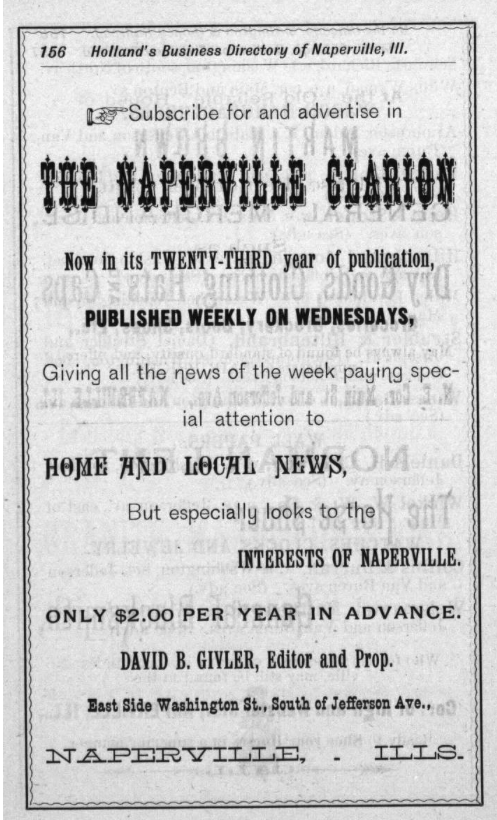
One of the advertisers in Holland’s Business Directory – and a major source of information about all the other advertisers – is the Naperville Clarion. While it is no longer in publication, the Clarion provided news to Naperville citizens for over 100 years. For many of those years, the Givler family served as publisher and editor.

A series of newspapers that were available to Naperville readers came and went until the 1860s. In the early days, folks read the Chicago Weekly Democrat and then the DuPage County Recorder. Other briefly published newspapers included the DuPage County Observer and the DuPage County Journal as well as the Naperville Newsletter and Naperville Sentinel.


During the Civil War, Robert Naper and Dr. Robert Potter founded the DuPage County Press, probably so locals could keep up with the national news. In 1867, after local boy David Givler had returned from the War and found his footing, he bought the Press and changed the name to the Naperville Clarion. Givler wore all the hats from reporter to editor to publisher and his motto for the paper was "Neutral in Nothing; Independent in Everything."

Givler was born in Ohio, but in the 1850s, his family relocated to the Copenhagen settlement which was around Route 59 and 83rd Street. He married Abbie Matter in 1864 while on leave from his war service and their early years were spent in Copenhagen while Givler taught school.

By 1867, they moved to Naperville and Givler became a pillar of the community. He was a well-respected speaker on history and current events and visited schools as well as clubs and organizations. He and Abbie raised three girls and three boys, with all of the boys serving at some point in the newspaper’s print shop.


Son Walter switched from printing to working for the First National Bank of Naperville. In his later years, he was instrumental in preserving early Naperville history, especially the Martin-Mitchell Mansion which had been given to the town by Caroline Martin Mitchell.


Son Oscar spent time in the print shop, too, as well as serving as town clerk, but he suffered from childhood with a “catarrhal affection” and underwent treatment at Edward Sanitorium. Unfortunately, he succumbed at age 47, leaving behind a wife and son.

David Givler published the Clarion until 1905 when he turned over the reins to his son, Rollo. David continued to write and speak during retirement, but he never rallied after his wife of 59 years passed away in the fall of 1922. He followed her on January 6, 1923.


Rollo ran operations at the Clarion and provided other printing services until 1951 when he sold everything to Mel Hodell and retired to California. The Clarion ceased to be published in the 1970s, but most issues are available for perusing through the Naperville Library’s website. They make for fascinating reading and with the search function, you can find great tidbits about Naperville families, businesses, and events.

Wednesday, November 16, 2022

Furniture Makers and Undertakers in Holland’s 1886 Directory

It was common for craftsmen who built furniture to also provide coffins and the Holland’s Directory listed two men in Naperville: Charles Babst and Frederick Long. 

The mass production of furniture was just beginning, so stores might offer both ready-made and hand-crafted items as well as furniture repair or other fine woodworking. Coffins were a natural offshoot of the woodworking business and providing funeral services was an added source of income. 

I’ve written about Frederick Long before, but here’s a review:    

Long started his career in cabinet-making in 1857. By 1861, he was operating his own workshop and had added undertaking by 1870. In 1861, he married Amelia Beidelman and they had one son, Charles, who only lived until the age of thirty and left no children from his brief marriage. 

Amelia’s nephew, Oliver Beidelman, worked for Uncle Fred and eventually acquired the business. He and his son, “Dutch” replaced the old frame building on the corner of Washington Street and Jackson Avenue with an impressively large brick building. Adjoining the building to the north was a space where funerals were held and you can still see the arched windows of the chapel on the second and third floors. 

The Beidelman’s Furniture business continues to be run by the family and still occupies the corner building. The funeral business is now helmed by a different branch of the family with two Beidelman-Kunsch locations in Naperville. 


Babst’s shop was on the corner of Main and Jackson, which is now the parking lot for Dean’s Clothing. Holland’s says that Babst has been in business “a long time” and has “a fine hearse,” but doesn’t detail when the business started. As Babst was a younger man than Long, no doubt he had less experience. The Babst family is buried in Saints Peter and Paul Cemetery and the Longs are buried in the Naperville Cemetery, so apparently Charles Babst specialized in Catholic funerals. 

Long seems to have been a savvy businessman. He formed a partnership with James Nichols and John Kraushar to launch the Naperville Lounge factory in 1893. They hired a young clerk named Peter Kroehler who eventually also became a partner and then the sole owner in 1916. The Kroehler Furniture Company was a major employer in Naperville for many years. Technically, that company closed in the 1980s, but the name continues to be used with other manufacturers.

Babst also married, to Catherine Bauer of Alsace, France. They had eight children together. Two little girls, Mary and Cecilia, died of scarlet fever in 1887. Edward was a victim of the Spanish Flu and died in 1918 at Great Lakes Naval Base where he was serving during World War I. 

Two other sons also served in that war, August and Julius, and both returned home. Julius was around forty when he went overseas and it was not the first war for him as an army chaplain. The Naperville Clarion published many articles celebrating Father Babst. 

A third son, George, was married to Mayme Kennedy in Los Angeles with his brother, the chaplain, officiating. Mayme died in her forties of a cerebral thrombosis and there is no evidence she and George had children. 

Daughters Rose and Anna remained in Naperville with their parents. They seem to have been musical. Anna taught piano and both were involved in theatrical productions in town. During that time, Rose advertised for a position as an “experienced children’s nurse” so they kept busy, but neither one ever married. 

Mother Catherine passed away in 1903 and soon after Charles sold his “3-story stone building.” An advertisement in an 1908 issue of The Clarion tells that Babst offered his funeral ““paraphernalia and good will for sale. A good opening for a Catholic.” 

Where the family went from there has been difficult to trace. Tidbits in the Clarion tell of travels to Kankakee, Springfield, Colorado, and other places so it seems they liked to travel. 

The 1910 census has father Charles living in Naperville with Rose, Anna, Edward, and August. In 1924, the Clarion says that Capt. Chaplain Bapst was visiting his father and family, so they must still be living in town, but the 1930 census records Charles, Rose, and Anna in New London, Connecticut. In the 1940 census, Julius is living at the Fort Lewis Military Reservation in Pierce, Washington, with father Charles, now 89 years old, and his sisters Rose and Anna, both in their fifties. 

Charles Bapst passed away in 1941 and his son Julius followed in 1943. George was already living in California and his sisters soon moved to California as well. George died in 1951, but the sisters continued to live in Santa Clara until the 1980s. Anna died in 1984 at the age of 94 while Rose lived to be 100, passing away in 1988. All of the family is buried in Naperville in Saints Peter and Paul Cemetery, save George’s wife. 


Wednesday, October 19, 2022

William and George Knoch in Holland’s 1886 Directory

William and George Knoch were a couple of young go-getters who ran a cigar factory and tobacco shop in town. The Holland’s editor praises William and George, saying “the business having been established three years ago by the former, and has grown to very respectable proportions.” Since William was born in 1864, that would make him barely nineteen in 1883, with George a couple of years older. 

The Knoch family were long-time Naperville residents. Father Christopher was born in Prussia and mother Josephine was born in France, but they were married in DuPage County in 1860. The birth of son George soon followed with five more siblings after him. 


Christopher was a tailor and had a shop on Water Street, now an extension of Chicago Avenue, which is still there today. The small, unassuming building has been empty, on-and-off, for a number of years. Most recently,  Dark Horse Pastries, Sugar Monkey Cupcakes, and Ehrina Yarn have been tenants.


Unfortunately, Christopher died in 1874, just 41 years old. Details on how Josephine supported her young family are difficult to discover, but according to the 1880 census, both George and William were already working. In fact, sixteen-year-old Willliam was a “segar maker.” I haven’t seen a direct confirmation yet, but it’s logical to assume William was working for Charles Schulz who had a long-standing cigar business that is also listed in Holland’s.


When the Holland’s Directory was published, the brothers had been in business three years already, operating out of a building on Water Street, which from the 1886 Sanborn Map looks to be where their father, Christopher, had his tailoring business. Also in 1886, the Naperville Light Guard, the original incarnation of our Municipal Band, had a group photo taken. You can see William in his band uniform with a tuba. His future brother-in-law, Theodore, is also in the photo with a drum and drumsticks. 

George married Gertrude Weismantel in 1890 and they had five children. He continued in the cigar business until after 1900, but by the 1910 census, George was working the Lounge Factory in town. 


William married his fellow bandmember’s sister, Adolphine Boecker, in 1893 and they had seven children together, two of which became nuns. Son Winfred Knoch worked for the family business as a cigar-roller to pay for his education at DePaul University in Chicago. After receiving his law degree, Win served in various county capacities and by 1930, was a judge. He and his wife, Irene, donated the land which became Knoch Knolls Park. 

William continued in the cigar business, although in 1901 he moved to Charles Schultz’s former tobacco store on the corner of Jefferson Avenue and Main Street. That location is also still standing, currently housing Blue Mercury. Previous tenants include Starbucks and Naperville Liquors. 

When Naperville incorporated as a city in 1890, wards were established and William served as a alderman for the Third Ward from 1892 until 1896. He was also a supporter of Naperville’s 1917 Homecoming celebration and the Doughboy statue installation.  


The Jefferson Street location was more than just a tobacco shop. Cigars were rolled in the two-room factory in the back. In the front. men could buy a hand-rolled Havana cigar for a dollar and stay to enjoy it while playing cards with friends. The floor above held a meeting room were groups such as the Independent Order of Oddfellows and similar organizations could gather. 

William passed away in 1931 and Knoch’s Cigar Store and Factory passed with him. If you go to the Naper Settlement Museum, you can see the Punch statue that used to stand outside of his establishment during its heyday. 

Wednesday, September 21, 2022

Tom Ley in Holland’s 1886 Directory

One ad in Holland’s Business Directory promotes “Tom Ley’s Chinese Laundry” and it is the only one advertised, although it’s possible there were other laundries operating in Naperville. Ads were run in The Naperville Clarion in 1885 for a laundry business run by Charles Ong Lung.  

Chinese laundries were common in the 1800s because of a series of discriminatory practices. During the 1840s, many hopeful men came from China to make their fortunes during the Gold Rush. As the boom fizzled out, however, large numbers of unemployed men of all races were left competing for too-few jobs. Growing conflicts led to anti-Chinese policies, including an 1875 law that prevented Chinese women from entering the country. In 1902, all Chinese residents were required to be registered and carry photo IDs.


Excluded from property ownership and the most desirable jobs, some Chinese men found employment building the railroad while others started washing clothes and linen. Native American and Mexican women had previously provided laundry services to miners and others, but these early entrepreneurs started seriously competing. Washing was considered “woman’s work.” Few men were willing to do it and those that did were not seen as “threatening.” Chinese laundries thrived in the west and started to move across the country. 


Tom Ley has been difficult to trace, especially since it’s highly doubtful that his name was really Tom. No people recorded in the 1880 census are listed as “Chinese” and a fire destroyed most of the 1890 census. A quick perusal of the cemeteries in the area didn’t turn up any Leys either. 


Ley’s “first-class laundry” seems to have operated for decades on Water Street before moving to Jefferson Avenue in 1907. Since the first location was down the street from the Pre-Emption House, those are probably glimpses of the shop in old photos. In 1916, the property under the laundry and a neighboring cobbler’s shop was purchased by the Naperville Masonic Temple Association. The temple building erected there is still in use today and houses the Naperville Running Company on the first floor. 


The Chinese laundry seems to have moved to 47 Jefferson Avenue, which is how it is recorded in the 1923 telephone directory. Tom Ley, however, is no longer listed as the proprietor. Instead, Sam Lung is the name printed. Or possibly Ley was no longer in business and this was a second laundry, the one mentioned in the 1885 Clarion ad promoting Charles Ong Lung, who may be a relation. Sam Lung is also mentioned in the 1917 Souvenir of Naperville Homecoming book which lists all of the local businesses that supported the Homecoming event. 

Other than these few references, history about these men has been hard to find. An article in a 1913 issue of The Naperville Clarion thanks “the Chinaman on Jefferson Avenue for his grand display of fireworks which is so freely given every year,” which probably refers to Charles Ong Lung or maybe Sam Lung, judging by the date. Sam Lung is also listed in the 1910 census. 


While there may not be records enough to trace, it’s important to do whatever is possible for a more complete understanding of our community’s past, however hard to face. Our history may not be particularly pretty at times, but you know what they say about being doomed to ugly repetition if we don’t learn the first time. 

Wednesday, August 17, 2022

Willard Scott in Holland’s 1886 Directory


Naperville had two bankers listed in Holland’s 1886 Directory, both of which were also merchant tailors first. Last time, we looked at George Reuss. Across the street from Reuss’s shop was that of Willard Scott who had been around even longer. 

In the early 1800s, Stephen Scott decided to move his family from Maryland to stake out a claim in Illinois. He sailed through the Great Lakes, much like Joseph Naper would a few years later. Rather than in the fledgling settlement near Fort Dearborn, Stephen chose land near Grosse Point, now part of Evanston. 

A few years after settling there, Stephen learned that their homestead had been awarded to the family of Antoine Ouilmette following the Prairie du Chien treaty. During hunting trips, the Scotts had explored land around the DuPage River and decided to relocate there, a few miles out from the Naper Settlement area. This was in 1830, the summer before Joseph Naper arrived with his community. 


Stephen’s son, Willard, was already a young man when the family moved to Illinois. During a journey to Peoria, he stopped at the Hawley homestead. Smitten by the daughter of the house, he asked her to marry him. Caroline refused the one-day’s courtship proposal and he continued his journey. On the way back home, Willard stopped again at the Hawley’s and repeated his proposal. This time, Caroline said “yes” and they were married July 22, 1829.

After a time, the Scott family, including both Caroline and Willard’s parents, moved from their farms and into the Naperville town proper. Willard and Caroline started a family and had three sons who grew into adulthood. 

One of Willard’s early businesses was the Naperville Hotel, which he ran for a number of years. By the 1840s, Willard and his oldest son, Thaddeus, were operating a general store on Washington Street. The business thrived and as Willard’s good reputation grew, farmers who traveled into town for supplies started asking him to hold their money. Officially, Willard started his private bank in 1854, the same year George Reuss was immigrating from Bavaria to New York. 


The bank survived the Civil War, as did the Scott sons, and the merchant business grew, but within just a few years, Thaddeus died at a New York restaurant after choking on his food. Willard, Jr. then stepped into the store partnership and in the late 1860s, bought out the business from his father, leaving Willard, Sr. to focus on the bank. 


The store, which was about where Sweetwaters Coffee & Tea is today, was enlarged and remodeled in the 1870s. A separate building was attached to one side for the bank and a spacious second floor ball room was added. For many years, Scott’s Hall was the largest space available and it used for community meetings, celebrations, graduations, and similar gatherings. 


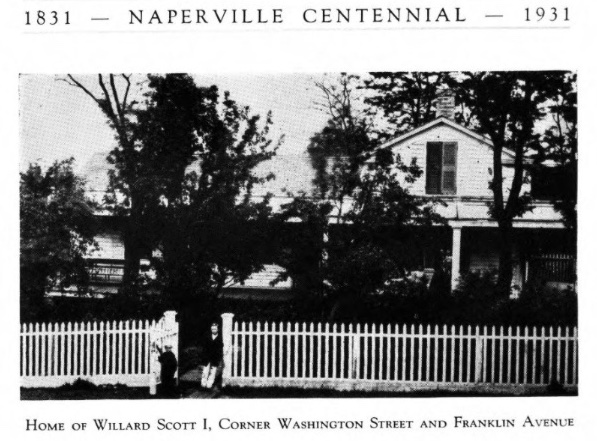
Around the same time, Willard Sr. was building his grand Italianate mansion on the corner of Washington Street and Franklin Avenue. It still exists today as the River Valley Law Firm and there are several interesting stories about it. Strangely, a photo in the Naperville Centennial book is labeled “Home of Willard Scott I, Corner of Washington Street and Franklin Avenue,” but that’s not the Italianate mansion in the picture. Perhaps the frame building in the photo was Willard, Jr.’s house on Jefferson? 


Another oddity is the front-page ad that ran for several weeks in The Naperville Clarion saying that Willard Scott & Co. was going out of business. These ads were published in January of 1886, the same year as the Holland’s Business Directory. Willard, Jr. seems to have sold the store in 1905, so it’s puzzling as to what the Clarion ads mean. 

Willard and Caroline lived good, long lives and their sons and daughters-in-law were quite active in town. Both Alvin and Willard, Jr. served as trustees in the village government for many terms and later, Alvin became treasurer and Willard, Jr. became mayor. Willard, Jr. was also the first fire marshall and his wife, Etta, was instrumental in launching the Naperville Women’s Club and they are all buried in the Naperville Cemetery except for patriarch Stephen Scott, the first to settle. Stephen’s burial place is unknown, however. Adventurous even into his seventies, Stephen started for California to pursue gold-mining and was not heard from again.

Wednesday, July 20, 2022

George Reuss in Holland’s Directory

While progress has replaced many of Naperville’s earliest structures, not only does George Reuss’s business building still stand but so does his home. And both are fine monuments to his maxim that "industry and economy lead to wealth." 

Trained as a tailor, Reuss left Bavaria in 1854, remaining for a time in New York until moving west to St. Charles, Illinois. Mathias and Gertrude Krapf, a family he knew from back home, also settled in St. Charles, bringing with them their daughter who was an old school friend of George’s. In 1856, Reuss married Anna Maria Krapf, moved to Naperville, and started a store with “a Mr. Dollinger.” This is possibly Franz “Frank” Dollinger as he also lived in St. Charles for a time and was a member of Euclid Lodge, the Masonic organization in Naperville. The partnership didn’t last long, however, and they split up the stock to go their separate ways. 

Now in his twenties, Reuss operated a clothier’s shop which sold men’s furnishings and utilized his tailor training. His obituary states that while Reuss was “a stern man, he was eminently just and demanded much more of himself than he did of anyone else” and his business seems to have flourished. In the 1860s, Reuss hired local contractor, Levi Shafer, to erect a fine clothing shop on the corner of Washington and Jefferson. In addition to being a successful builder, Shafer is known for loaning his gun to Marcellus Jones who is said to have fired the first shot of the Battle of Gettysburg with it.  


Reuss’s good reputation and sturdy building impressed the farmers and townsfolk who were his customers and they started asking him to hold their money. So the clothier became a banker, launching the Bank of Naperville in 1886. Isaac Murray, brother to the Ruth that I wrote about in my first book, was vice president of the bank. 

George installed a vault and added another room and rebuilt the entrance with elegant red granite to better reflect the change from tailor to bank. These additions cost him $13,000, equivalent to $397,117 in today’s dollars, and the fancy entrance now opens into ZazĂş Salon.

Over the years, Reuss also served a few terms as town trustee and in 1880, he was president. But there were difficult times for the Reuss family as well. Of the nine children born to Anna Marie, five died in infancy and one before her fifth birthday. The three remaining children prospered, however, providing thirteen grandchildren between them. As an adult, son Joseph joined George in the banking business, as did son-in-law, Valentine Dieter. 


The younger men’s responsibilities, naturally, increased over time, particularly when George was felled by a series of strokes. After two years of being home-bound, George passed away in 1901.  His wife continued to live in Naperville until her death in 1907 and both are buried in Saints Peter and Paul Cemetery. 

During the late 1870s, George and Anna Marie had a beautiful home built in Naperville for their family to enjoy. It was designed to resemble the villas found in northern Italy, which was a popular trend during that era. The home of Willard Scott, who also ran a store and bank on Washington Street, is another fine example of Italianate architecture. 


The grand house was eventually split up into a six-flat, but it received a big make-over in the 1990s, returning it to its former glory as a single-family home. In 2013, North Central College purchased the beautiful building to house then-incoming President Troy Hammond and it remains the college president's home today. 

Wednesday, June 15, 2022

“Sample Rooms” in Holland’s Directory

Naperville today has an abundance of drinking establishments and it was much the same in 1886. In fact, there were six saloons in the downtown area and one out by the train depot for a population of just over 2,000. 

These drinking establishments called themselves “sample rooms” which was a name leftover from when distributors let commercial customers sample stock before purchasing. The sample rooms in Naperville actually catered to folks who wanted to relax with a beer, a cigar, and a game of billiards, both locals and travelers. The Pre-Emption House was listed under “Hotels” and not “Sample Rooms,” but probably travelers could also buy food and drink there, as they had for since its inception.

Adam Conrad ran the sample room south of the railway station. Not a lot has been found about him other than the fact that he married Josephine Adams and they are both buried in Saints Peter and Paul Cemetery. One supposes that he particularly catered to folks waiting for a train and perhaps railroad employees. 

The in-town sample rooms were run by some more familiar Naperville names. We talked last time about Jacob Keller, who, yes, is related to Ron Keller of the Municipal Band. He started with a sample room, expanded his business with a hotel on Washington Street, and then returned to his original location with a scaled-down hotel and sample room establishment.  

Mrs. Caroline Fuchs is the only woman who has a sample room listed. She was featured in March for Woman’s History Month. Originally, Caroline’s husband, Fred, ran the saloon, but he died in 1886, apparently just before Holland’s Business Directory was published. 

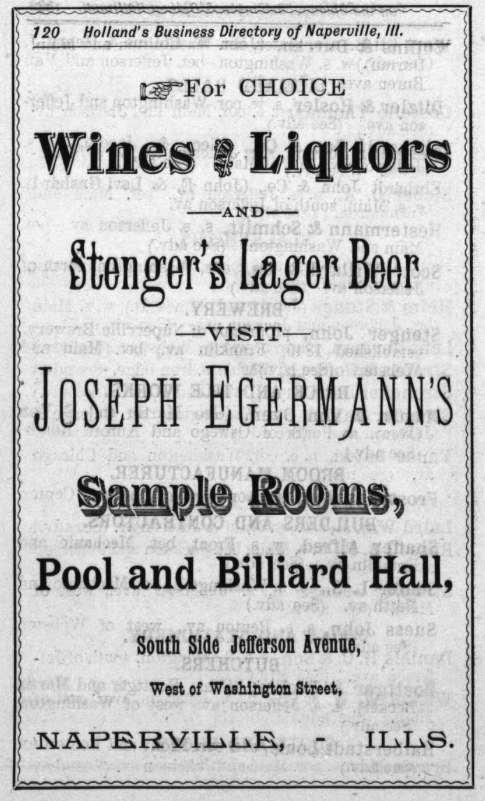
Egermann is a well-known Naperville name. Xavier Egermann immigrated from Germany in 1846 and both he and his son Joseph had their hands in several businesses, including the Naperville Butter and Cheese Factory. Xavier purchased a brewery from Jacob Engelfreidt, which was probably the first in town, and also ran a sample room. The Egermann family sold their brewery in 1872 but continued operating a sample room, located where Naper Nuts and Sweets is today. 

The Engelfreidts had built a bigger operation, but they sold that one also – to the Stenger family. Barbara Stenger married Joseph Egermann, so it’s hardly surprising that in Holland’s advertisement they feature “Stenger’s Lager Beer.” Barbara and Joseph were the parents of Mary Barbara “Matie” Egermann who was the long-time librarian at Nichols Library. It is Matie’s library that is depicted in the diorama kids love to look at in the lobby. 

August Clementz, Thomas Costello, Xavier Schwein, and Otto Sieber may be less familiar names today, but they all were long-time Naperville residents back in 1886 when they were proprietors of sample rooms with billiard tables. Schwein’s history is the most elusive and all that could be discovered is that he immigrated from France, was married to Antoinett, and was the father of five children.

Clementz and Sieber became sample room proprietors after retiring from other professions. Clementz was a tinsmith and worked in the hardware business, mainly in Naperville, but also for a brief period in Prophetstown. Sieber was a stonemason. After training his sons Hultrich and Henry in the trade, he let them continue that business while he retired to be a saloon host.   

Beyond being buried in Saints Peter and Paul Cemetery, little could be found about Thomas Costello. He must have been quite the upstanding citizen, however, as Holland’s Directory made a big deal out of the fact that his “business place is a model of its kind, wherein, we are well advised may be found at all (legal) times the best beverages in the market, while order and system are very pronounced.”

John Ruchty seems to have spent less time in Naperville, although at one time he also ran the Pre-Emption House, according to The Du Page County Guide. He was also a Frink and Walker stage driver in his early career after immigrating from Switzerland. In mid-life, he married Margaret, a widow with ten children, and they moved to Fullersburg to run a tavern there.

Improved bottling and distributing techniques meant that saloons could offer more than just beer that was brewed locally. The late 1880s was a boom time for breweries and competition started heating up which prompted exclusive brewery partnerships. As you can see from the ads, Costello advertises Schlitz, Sieber sells Brand’s, and Fuchs features Blatz. Egermann proudly serves the local brew, Stenger’s, because of his family connections. 

In bigger cities, breweries purchased buildings, decorated and outfitted them, and installed managers that sold their products exclusively. Even with this emphasis on specialty beer, this doesn’t seem to be the case in Naperville and the sample rooms appear to be owner-operated. The Encyclopedia of Chicago has a great essay on city saloons

Unfortunately, none of the featured beers are being made today. Stenger stopped brewing in 1893 and Blatz in 1959. Schlitz didn’t quite make the new millennium, ceasing operations in 1999. Brand’s Beer survived Prohibition but shut down by 1935. Brand’s might be a less familiar name, but their brewery building was still visible on Elston Avenue in Chicago, at least until recently. It’s awful hard to tell from Google Maps. 

Although Caroline Fuchs ran her own establishment and one surmises that wives may have assisted the other owners, it’s hard to tell if women frequented these sample rooms. That research will have to wait for another day!