Wednesday, September 16, 2020

Naperville 1920 Flashback: Power Farming


1920 was the first year that America’s population tipped toward an urban rather than rural majority. DuPage County and the surrounding area was still mainly farmland and towns like Naperville supplied farmers’ needs. Motorized tractors for the most up-to-date Power Farming were quite new. Henry Ford and his son Edsel had only started offering their Fordson tractor in 1917. It ran on kerosene and was intended to replace horses and oxen on farms. Because Ford’s automobiles had already created a widespread sales network, Fordson tractors were a favorite purchase.

The Cromer Bros. in Naperville sold the Henry Ford & Son tractors as well as the Mogul 10-20 from International Harvester. According to the Naperville Clarion newspaper ad about a “Power Farming” presentation, they operated out of a building at 22 Water Street. When one looks at the 1921 Sanborn map, however, it’s clear that this earlier Water Street is on the opposite side of the DuPage River from where Water Street is today. 

https://www.loc.gov/resource/g4104nm.g020381921/?st=gallery

That short stretch of Water Street in the 1920s extended from Chicago Avenue where Washington Street intersects and is now considered part of Chicago Avenue. This Clarion ad invites farmers to 22 Water Street and looking at the Sanborn map, there is a “Farm Machinery” building identified at that location, which seems to place it east of today’s Empire restaurant, where the photography studio is now. All of the buildings on that side of the street have changed hands many times and exactly which building housed Cromer’s I have not been able to confirm. 

International Harvester Company of America., 1917

Motor Co. Inc. is also listed in early 1920s directories across the street at 13-19 Water Street. In 1946, the Preemption House, which was at 25 Water Street, was torn down and Cromer Motors grew into that space as well. Today, that is the home of Sullivan’s restaurant. 

Unfortunately, as the decade wore on, agriculture faced a combination of factors that sent farming into a tailspin. After the first World War ended, there was less demand for grain and Prohibition contributed to an over-supply since grain was not needed to make alcohol either. At the same time, mechanical farming was improving yields which resulted in a drastic surplus and falling prices. The plight of farmers preceded the Great Depression by several years, even while urban dwellers thriving.

Wednesday, August 19, 2020

Naperville 1920 Flashback: August’s Blackbirds

In 1920, Naperville was just a small, mainly rural, community with a population of only 3,830. It was so rural, in fact, that City Council minutes listed expenditures for horse feed and shoeing that were regularly paid to August Springborn, the Assistant Superintendent of Streets. Although the minutes don’t say exactly what Springborn needed a horse for, he probably used a cart rather than a truck for his work on the streets.

Naperville’s residents in 1920 were no doubt more tuned into their environment than most of us are today. The Chicago Tribune carried a column by Larry St. John called “Woods and Waters” in which St. John discussed such outdoor sports as casting, which was a popular competitive activity in the early 1900s for all ages and genders. 

One of St. John’s readers wrote from Naperville asking for advice on how to get rid of annoying flocks of blackbirds that congregated every August in town. They roosted in trees in great noisy numbers and made a mess on the sidewalks that in the late-summer heat was really unbearable.

Another reader from Kalamazoo wrote in to comment that it sounded like Naperville had grackles rather than true blackbirds and that many other towns had a similar problem. 

Those of us living in the now-mainly-urban city may not notice it, but our birds’ habits have changed since May. We used to hear a lot of birdsong in the early morning as avian families marked out their nesting territories, but the songs wane towards summer’s end because the children have, quite literally, left the nest. Parent birds now spend their time recuperating from the demands of childcare, molting and resting up for fall’s migration. 

This pre-migration breather is why the grackles were flocking in Naperville, but they were still a nuisance. The Kalamazoo writer had a suggestion that was seconded by several other letters. Apparently it was common to sneak up where the birds roosted at night and shoot Roman candles into the trees. 

There is no follow-up column saying whether Naperville citizens actually tried this remedy or if it worked!

Wednesday, July 15, 2020

Naperville 1920 Flashback: Going to the Pictures

The Masons built their new lodge in 1916 and outfitted the second floor for their own use while renting out the first floor. On the street-side were a couple of shops, but an entrance corridor led to the back of the building and the Grand Theatre.  


The Grand opened in 1917 and boasted 350 seats. It paid the city of Naperville an annual license fee to operate, which according to council minutes, started at $15 per year and went up to $60 per year by 1928. 

While it’s unclear whether there was an organ or piano in the theatre, there probably wasn’t a sound system, at least for most of the Grand’s existence. “Talkies” were being made, but were not commercially available until 1923, and even then, they didn’t really catch on until 1927. Instead, folks would come into town to watch “one-reeler” comedies and cartoons or short silent feature films like “When the Clouds Roll By.” 

The Grand operated from 1917 until 1931 when it closed down, perhaps due to the aftermath of 1929’s crash. In 1935, however, the space was enlarged by incorporating the street-side shops and updated to seat 480 patrons. Outside, it was dressed up with a fancy sign and marquee and renamed the Naper Theatre.
 

The theatre was enlarged again in 1950 and received a new CinemaScope screen a couple years later, probably around the time this photo was taken in 1952. By the 1970s, however, competition from multi-plex theaters became too much and the Naper Theatre closed for good in 1977. 

The space housed an appliance store and an antiques mall in the years that followed and since 2010, it has been home to the Naperville Running Company. The Masons of Euclid Lodge continue to meet on the second floor and held an Open House last fall to celebrate their 170th anniversary.

Wednesday, June 17, 2020

Naperville 1920 Flashback: Buying and Washing Clothes

Flapper dresses and wild spending are the stereotypes, but in 1920, hemlines were still fairly long and “The High Cost of Living” was a major campaign issue. Prices were expected to fall after the war ended, but because of inflation, labor costs and continued scarcity, they stayed high  and peaked in 1920, the highest Cost of Living ever recorded. 

But folks were also weary of war deprivations and ready to spend their war bond investments. The Naperville Clarion complained that “There probably never was such a wild orgy of buying as at the present moment.” 

One favorite expense was to invest in an electric washing machine to lighten the load for women. If you look at the ad for the Crystal Washer, which was made by Mallory Industries, you can see the Mallory logo between the washer’s legs. The image depicts a man lifting a bundle of clothes off the back of a kneeling woman. Make of that what you will.

In these early electric washer/wringers, the motor automatically agitated clothes in the washer. But then you needed to wring out the wash water, put the damp clothes in a basket, empty the washer, refill with clean water, and run the electric agitator again to rinse out the soap. If you were washing whites, you might have bluing rinse as well. One more wringing later, you were finally ready to hang your clothes in the yard to dry before ironing and folding. So much easier!

This ad for a Crystal Washer and Wringer is from the Naperville Clarion newspaper for Hillegas Hardware. Hillegas and Reich opened a hardware store in downtown Naperville in 1882 in the building where Frankie’s Blue Room and Features Bar and Grill is today. Apparently before the year ended the store became
Rassweiler Hardware, but the January advertisement is definitely still identifying it as Hillegas Hardware, the place you can buy your wife a Crystal washing machine.

Wednesday, May 20, 2020

Naperville 1920 Flashback: Cornerstone Day

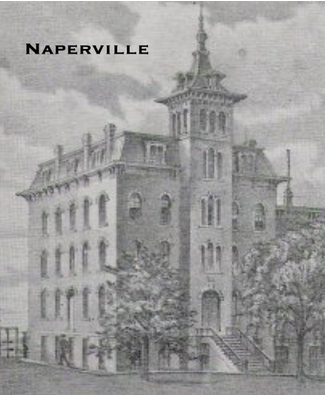
Naperville’s North Central College has not always been called North Central nor has it always been in Naperville. The Evangelical Association of America founded Plainfield College in 1861 with the idea of “uniting a liberal arts education with religious teaching”* and offered a coeducational program from the very beginning. By 1864, the school’s name was changed from Plainfield to North-Western College in the hopes of attracting a more regional student body.

After weathering the Civil War, the college’s administration considered further plans for growth. The college was located right downtown, near modern-day Route 59, but Plainfield was not then reachable by railroad and the administrators concluded they would do better in a railroad town.

After much research into various nearby towns and several deal-making discussions, North-Western College decided on Naperville which offered both land and money towards a new building. The cornerstone for Old Main was laid on May 17, 1870, and with extensive work, was completed in time for dedication by October 4 and the fall semester.

Cornerstone Day was especially celebratory in May of 1920 when the school celebrated the 50th anniversary of its move to Naperville. A few years later in 1926, the college’s name was changed once more, this time to “North Central” in order to avoid confusion with some college located in Evanston.

NCC continues to flourish, adding new buildings to the campus and new educational opportunities to the curriculum. For years, the college welcomed the entire community to a Cornerstone Day picnic in May, but the event was replaced with an awards reception in 2019 and then retired entirely. Even though no celebration was planned for 2020 and COVID-19 would have cancelled it anyhow, this year is a particularly special anniversary, so Happy 150th Cornerstone Day Anniversary, North Central College!

*A Time for Remembrance: History of 125 years of First Evangelical United Brethren Church, Naperville, Illinois

Wednesday, April 15, 2020

Naperville 1920 Flashback: The Kroehler Co. Baseball Team

In May of 1920, Kroehler Manufacturing put together a baseball team for the Fox Valley Industrial League. The team reads like a “Who’s Who” of Naperville history including:

F.J. Wehrli – lived in the Pre-Emption house and raised 13 children there
Robert Shimp – his family had a local farm and some served in the fire department
Clarence and Albert Stenger – of the brewery family
Louis Germann – his family started with a harness business in the 1890s
Fred Yanke – Naperville firefighter
Henry Stoner – family started blacksmith shop in 1870s
James and Clarence Kroehler – nephews of Peter
Joe Haas – his brother Bert became a pro ball player
Ernest and William Voss – brother Julian ran for Police Magistrate
Elmer Otterpohl – the family had a butcher shop and sausage business
Leo Koppa – served in the fire department
Clarence and Frank Barley – Clarence was involved in building the YMCA
Fred Shupp, Ray Ballman and Jeff Burke are also listed. They were all Kroehler employees, but kept lower profiles, apparently, since there wasn't much to be found about them. Many of these men also served in World War I.

Peter Kroehler was wildly successful, but the company also weathered quite a few storms. Some storms were literal – like the 1913 tornado that destroyed the first 5th Avenue factory – and some were more figurative such as the Great Depression. Kroehler himself spent two months in the early 1900s quarantined with smallpox. But he continued developing new ways to run his business and build employee morale which resulted in enviable success and loyalty.

100 years later, our own businesses in these opening months of 2020 are facing both figurative storms and quarantine. Now it’s our turn to develop new ways to run our businesses and build employee morale so we can also be wildly successful.

By the way, the newly-formed Kroehler team faced the previous year's pennant winners for their very first game. You'll be happy to know that the Kroehler team won!

Thursday, March 19, 2020

Naperville 1920 Flashback: Big Fires Start the Year


Fire activity doubled in 1920 with three big fires occurring in the first three months. While the city normally faced maybe 10-12 fire events a year, there were 20 fires in this start to the new decade.  

At the time, fire department boasted one motorized chemical engine and the “Joe Naper” hand pumper in addition to the traditional bucket brigades. Naperville’s fire department was established in 1874 when there was no city-wide electricity or water and sewer system and not even a street numbering system for addresses.

These improvements, however, were in place by the early 1900s. The city also purchased a 1916 International Chemical Engine, the first that wasn’t powered by a team of horses. The chemicals in the Chemical Engine were a soda-acid combination that helped propel water onto a fire.

According to records, most of the fires that year were related to chimneys, perhaps due to an exceptionally cold winter, but of note were three major fires. The main infirmary at the Edward Tuberculosis Sanitarium burned in February, which was listed in the log as due to crossed wires. Personnel tried to save the recently-installed x-ray machine, but unfortunately they couldn’t drag it far enough away from the falling debris. In early March, there was a fire in a factory on the Hunt Estate and a second fire mid-month at the Judge Goodwin mansion known as Heatherton.

While these three fires caused a total of $1.75 million worth of damages, no lives were lost – at least not in the fires. Judge Goodwin died in Chicago on the same night that his home burned down and there has been plenty of speculation about that coincidence.  A Fire and Water Engineering book from that year says the fire is “believed to be incendiary.” One rumor suggests that the Judge’s servant was instructed to destroy Mrs. Goodwin’s inheritance once she was widowed. The Heatherton property was eventually purchased by North Central College with financial assistance from Peter Kroehler and is currently home to the fieldhouse.